
Thoughts About Rules and Roots
On Medium and Process

Last week I unplugged from everything, and took a beat, hence radio silence. But this week I’m back at the coal face of figure drawing! 💪 …and I wanted to share some thoughts about ‘mediums and processes’ that came up strongly while I was making some drawings for a recent group exhibition. My hope is that these ideas that have been floating around resonate with you and your drawing practice in some way. Because one thing I hear a lot from life drawing artists is that they wish they could be more free in their approach, even when working closely from reference or the model. And for me this is critical to the way I personally think about drawing. So here goes…
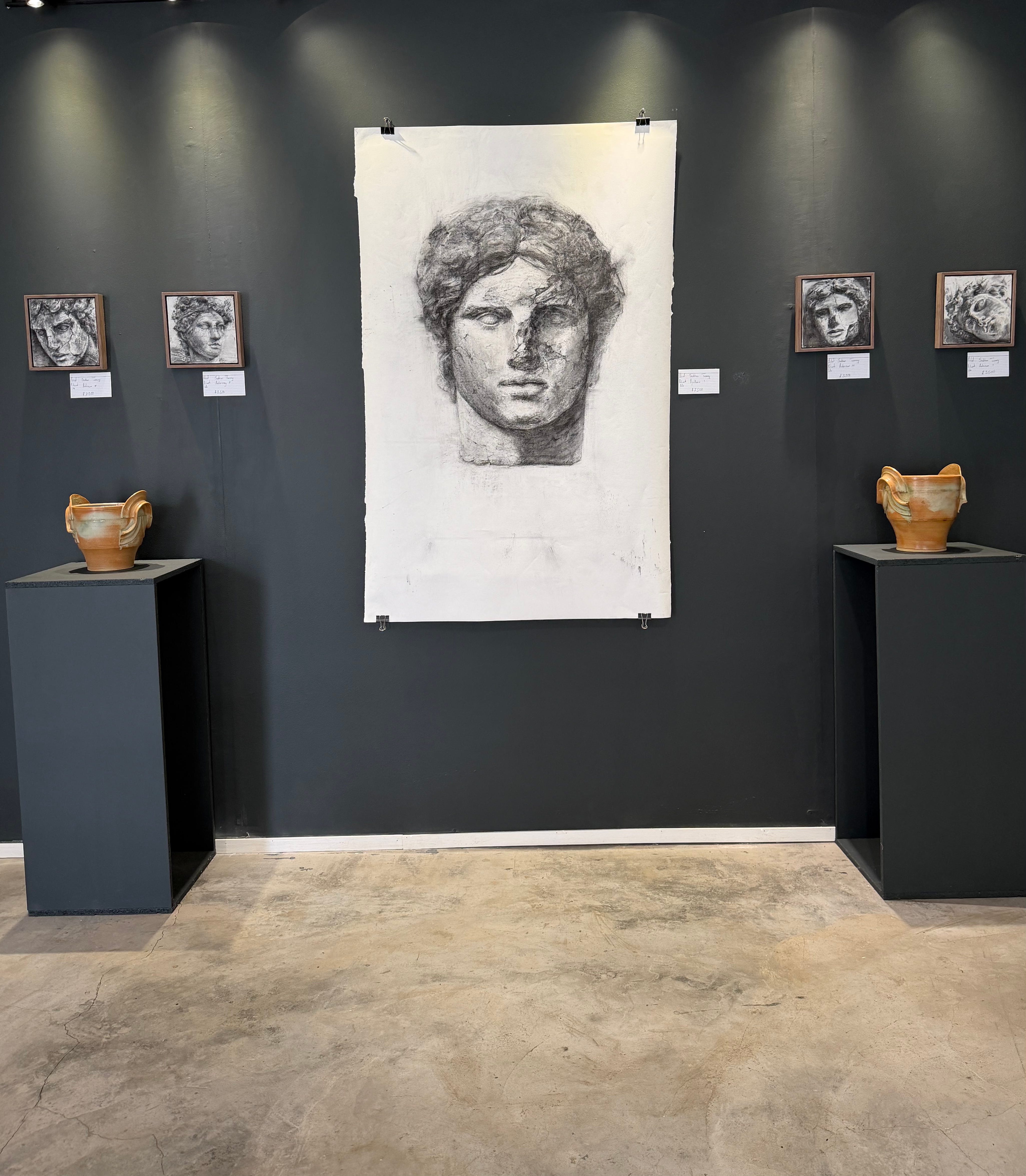
I was recently invited to participate in a group show titled “Portrait Re -Imagined”, alongside some incredible artists. The curator told me half jokingly that since most of the other participants were very conceptual in their practice she wanted to include a figurative artist as balance. To which I immediately thought - oh you don’t think figurative artists can be conceptual. Challenge accepted. 😂
Thoughts About Figuration
I’ve been noticing that lately, in the last few years, there has been a shift in the subject matter of contemporary art. A massive shift - towards figuration. With this shift back towards representing the figure / the body / ourselves, and with the current imaging tools that can support hyper detailed, photo realistic work, there is an equally noticeable emphasis on “basic visual aspects”. And that has led to a loud insistence on the need to learn classical, academic and formal approaches before ever attempting to draw portraits or figures.
More interesting is that for some notable contemporary artists, this approach is used to hammer home the commonly accepted viewpoint that: “Western culture loses meaning when it is severed from its roots.”
Thoughts on My Process
Firstly, for me and my practice anyway, those roots feel broken. Secondly, those roots seem to have solidified into a set of rules that govern formal approaches to art - form, structure, and technique - that often suppress impulse, response, and instinct. The gesture is rarely allowed to be the final outcome, or the thing that is actually said by the work. Instead, only one aspect of experience is privileged.
So, I decided to make drawings based on classical Greco-Roman busts, as an entry into a discussion about inherited rules of portraiture in Western art. And what inheritance means in this tradition, in general.
I definitely don’t think we need formal training to create beautiful realism and accurate drawings. But in my work, I don’t often achieve that level at all. So, the drawings I made prioritized an experimental and instinctive process over the outcome, in order to arrive at classical form. I intentionally wanted to invoke archetypes - the Apollonian ideal, the heroic, the eternal, the beautiful. Not to adhere to legacy, but to reinvent a new vision of those archetypes through the act of drawing. Or, through the act of discovering the drawing. So, in a way it was the process that became completely abstracted: throwing charcoal powder onto the surface, using sandpaper as a drawing tool, erasing and wiping back carefully to find the image. Drawing only occurred at the very end, to create fine texture and cracks.
I also worked with materials that, for me, are anti-monumental. Charcoal powder and marble dust. Charcoal is a dynamic and expressive medium, and I love it for that. But also, it is likely the first medium we ever used to create, express and make sense of our world, long before we put rules on how we must express ourselves. I think of charcoal as dusty, ephemeral and unstable. A medium in tune with the flux and flow of life; a medium that resists the need to batten things down and make something stay one way forever. In fact, to come back to my starting point, if Western culture loses meaning when severed from its roots, I wonder…. aren’t our roots in charcoal though, not in marble?
Controlled Process vs Emergent Process
I was completely unsure of the work that was emerging, while I was making it, and unsure if I would show it, but at the same time, I felt total trust in the process and allowed that to lead me.
I think there is a way to create work that forces outcomes by strictly controlling the process and by strictly applying controlled rules. Sticking to established ways of doing things. Not letting the intended outcome out of your sight. Doing everything to pin it down.
But there is also a way to create work that allows the outcome itself to emerge by itself, by simply holding that process in your hands, using your reference as a starting point, and allowing something entirely new to come into being.
I’m sharing all of this simply to affirm my intention to champion a way (in drawing or otherwise) that is not bound by rules, but is freed by instinct. There are lots of ways to make work, and lots of other teachers offering valuable processes, but for me instinct is a powerful guide that will never steer you wrong. It allows you to discover your own process. Your own expression. Your own freedom. I am here to support you to uncover and develop your unique facility in that process.
Hope this post was helpful, thank you for reading!
Wishing you a wonderful week,
Siobhan
❤️
Echo Tom on what attracted me to your work - it's energy and dynamism; hadn't seen anyone else draw like you do. Still working with you to unlock my own intuitive artistic voice. Your essay is thought provoking; I'll have to re read a few times and let it absorb - thank-you
Thank You Siobhan,
I was attracted to your work with Drawing Life because of this intuitive spirit . Using gesture , expressive mark making , feeling , energy and motion. Charcoal. I still feel carful about organization , proportion and all the classical concerns because they are canons of beauty that I want to include , but the artistic voice that I wish to develop is in this direction that you are revealing.