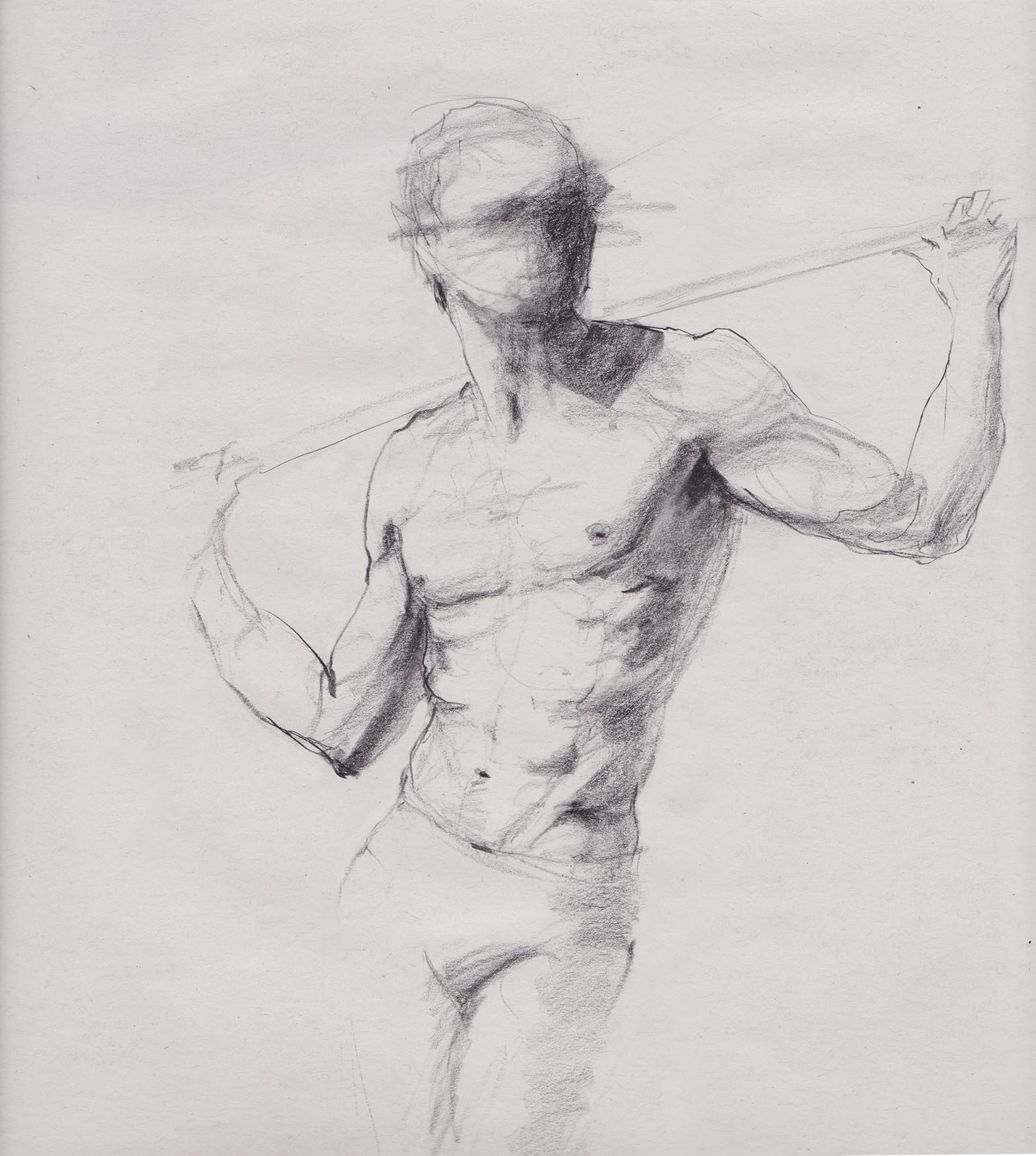
Torso Study
Figure Drawing Demo

Happy Monday Drawing Life fam 😊
On Friday I published a video on my YouTube channel of a quick Torso study, and I wanted to share the link with you here in case you missed it.
👉 Tips for Drawing the Torso
If you are here because you followed my prompt to join this Substack, then you’ve already seen the vid, and I wanted to say thank you so much!! I was delighted to see that a lot of my YT subscribers joined this newsletter ❤️
A few words about doing a Torso study:
You’ll know that my entire approach to figure drawing favors an intuitive and natural way of drawing over a strict academic approach. Or even an approach that “simplifies” the forms and turns them into stylized shapes. I think it’s imperative that figure drawing students learn DRAWING before they learn anatomy. And to that end I encourage people to use their line to search out the forms that they see, instead of bending their lines to fit shapes or conceptualized forms - even if those conceptualized forms are accurate muscle shapes (since they’re still conceptualized in a sense).
Sure, having a knowledge of anatomy can only benefit and improve your drawing. But “drawing” comes first. Drawing as a controlled - or free - form of expression.
Drawing as a method of explaining something in line.
Drawing as a vocabulary and language that is all your own, no-one else’s.
“Anatomy in the hands of the artist is merely another instrument for making the figure articulate and clear. It is never to be thought of as an end in itself but only as a means to an end. It is quite possible for a student to acquire sufficient knowledge of anatomy through his knowledge of the figure without having made any special study of the subject or ever having heard the word. The archaic Greeks knew little of anatomy and their figures are anatomically inaccurate, but they constitute great works of art.”
- Kimon Nicolaides, The Natural Way to Draw
When it comes to the Torso, there are really just a handful of things that I try to identify on the model by LOOKING. I don’t assume these landmarks, or draw them how they should be, rather I check where they are and what they look like, and try to make a drawing of that. Those landmarks, or things that I look for are: The tilt or angle of the ribcage versus the tilt or angle of the pelvis. This literally means - the bend of the torso - is it bending to the left or to the right, is the chest pointing towards us or away from us.
Then I look for the tilt of the shoulders and the tilt of the hips.
Finally I check where the mid-line of the torso is - that line that runs from the pit of the neck to the naval.
With these in place you have a solid structure of the entire midsection of the body. And that is vital to get into your drawing if you do want to develop it into a more finished piece, with shading and even to draw in, dare I say, Muscles 💪
So, even as an exercise in drawing - I would encourage you to let your line work do the exploration and the finding out.
Let your line be searching, and follow it with intensity to discover shapes, volume, heaviness, movement, and life in your subject.
Don't assume you know the shape of the thing you’re looking at until you’ve explored it fully with your line, and can tell us what you’ve discovered. Your drawing could tell us something that we’ve not known or understood until this point.
I hope this gives you some useful info, and supports you in an expressive drawing practice, and if nothing else, gives you a handy alternative to drawing the figure when a strict, structured approach doesn’t quite fit what you are trying to express.
Have a wonderful week!!
(And, to my paid Subbers - remember, we are drawing every day! I will open a couple of threads for you, and follow up with a full post at the end of the week!)
Stay healthy and safe,
Keep drawing and always keep looking!
❤️