
Gesture Studies
Anatomy as a Means, Not an End, to Drawing

Happy Monday everyone! Our book study club continues this month with further exploration of “The Natural Way to Draw”. If you would like to join, then consider the monthly or annual subscription. You can also have access to the weekly chats where we share our work and discuss our drawings.
📣 Announcement! I’m currently accepting commissions!
We are heading into gift-giving season. If you would like to commission a portrait painting in oils, or a conté drawing of a loved one, relative or friend, then please contact me via email, and I’ll send on the information about specs, prices and options.
email for quotes: siobhan.mlt@gmail.com
“The best approach to the study of anatomy is that which constantly relates the anatomy of the figure to the possibility of movement.”
- Kimon Nicolaides
Figure drawing to most people would seem to be simply a study of anatomy. Get the anatomy right, and you’ve got the figure down. Except that an approach to drawing that focuses predominantly on anatomy tends to treat the figure as, well … a still life. On the other hand, an expressive and dynamic approach to drawing the human form such that I write about here and post about over on Youtube, is one which studies the movement of the figure. And movement = life. In essence, we are drawing LIFE, not anatomy.
Learning to draw anatomy will not actually help you to draw better. A study of the muscles and bones of the figure should only help you to understand the structure in order to know what to draw. But drawing itself will only improve when you focus on two things: how you observe and how you make marks. Observation and Expression.

Both of these aspects, how you observe and how you make marks, are actually the only two things that make you better at drawing.
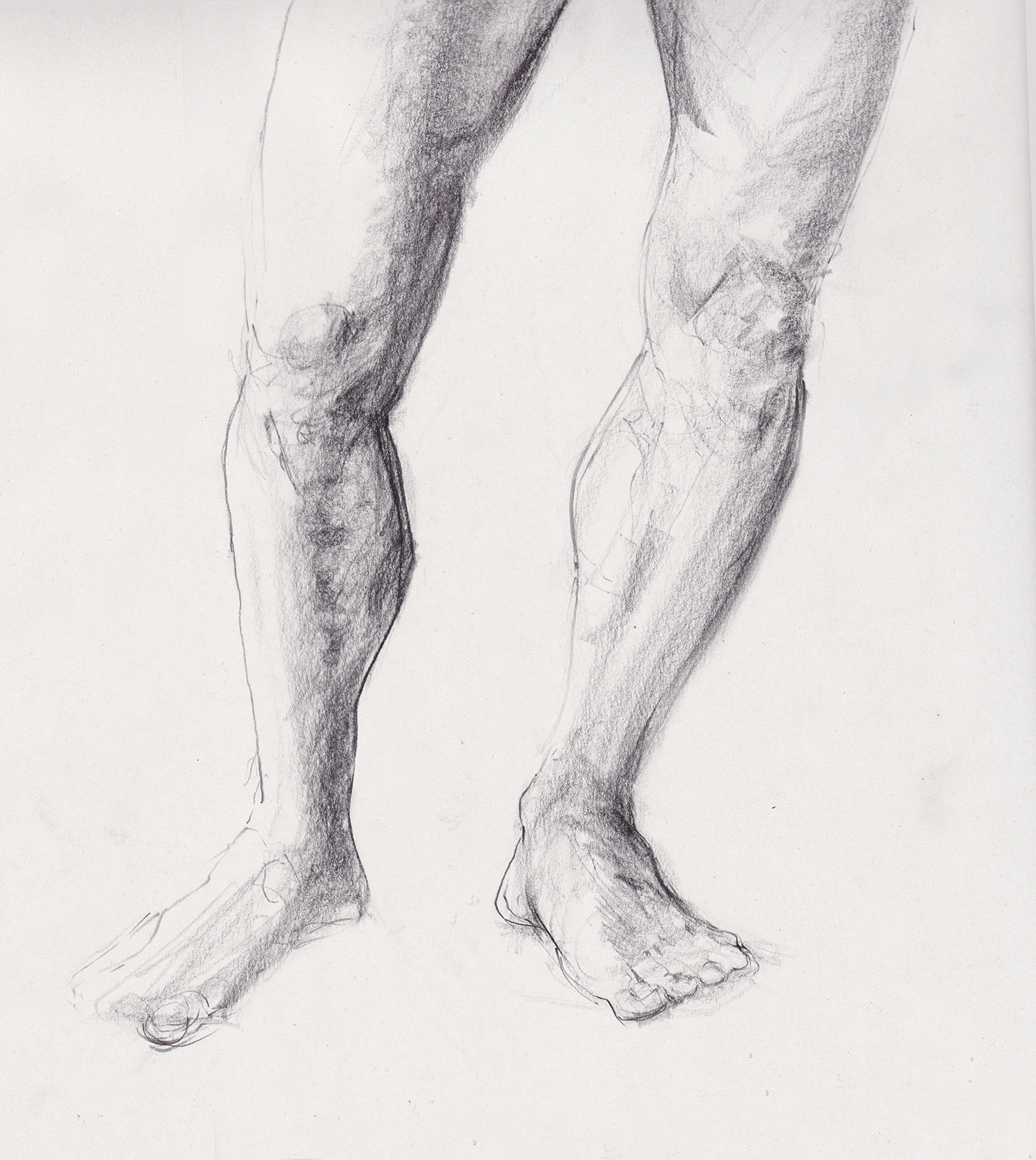
A great exercise to do, to improve both how you observe and how you draw, is the one I shared this week over on Youtube: using gestural drawing to explore and discover shape and form.
Click here to watch it if you haven’t seen it yet:
This is an exercise that deliberately avoids breaking the forms down into categorized and labeled parts, and instead actually helps you to unify the drawing through your marks and lines. It’s an exercise where you place the focus on observing the rhythms and flow lines that the structure of the anatomy (in this case the leg) makes. And by observing this rhythm and flow you aim to match your marks and lines to that.
You are only concerned, in this exercise, with the observable forms - what you can see on the surface as indicated by contours, shadow and shape.
But, what about beginners. Surely someone experienced like myself already knows anatomy so it’s way more easy for someone like me to make a “good “ drawing of the leg because that’s already ingrained in my experience: it’s somehow a “blind spot” that I simply don’t realize I’m already good at drawing anatomy. Right?…
Completely not the case. For one thing, whether you are a beginner or an experienced artist, the most amount of anatomical knowledge that you need in order to draw a leg is as follows: knee, ankle, upper leg, lower leg. Why? because the human figure, as a subject, is something that we have a unique and innate first hand knowledge of: we are bodies ourselves!! ✊
The figure is the only subject in the world that we actually embody and have that sort of experience of. Knee, ankle, upper leg, lower leg - anyone can identify those parts. And so to be told that you need to, or should, know medical grade nomenclature of the parts in order to draw is absurd. Secondly, I will admit here, to you, that I’ve never studied anatomy in an academic sense. Maybe that, in truth is my blind spot. I don’t know the names of the muscles of the leg. I have learnt everything about the structure and form of the subject through observing. Maybe that has resulted in making my drawing journey take somewhat of the long way round, but it has served me well and offered me a direct experience rather than a second-hand experience. And a direct experience is what I cherish most over and above accuracy.
I think this is an approach will serve a great many artists who feel stymied and frustrated by the idea that you need to know the latin names of muscles and tendons in order to draw them well.
My advice is: focus on observation first, and your lines will follow. Observation will lead you to discover things about the figure - and more importantly about yourself - that you can’t know or learn from dry, abstract or stylized academic study. Use an academic study to support your understanding of what to look for, but always trust what you see. The more you do this, the more your lines and marks will start to reflect the way you look.
I hope this is helpful and supports you in your drawing! Let me know in the comments any thoughts or insights.
Wishing you a wonderful week,
Siobhan.
❤️