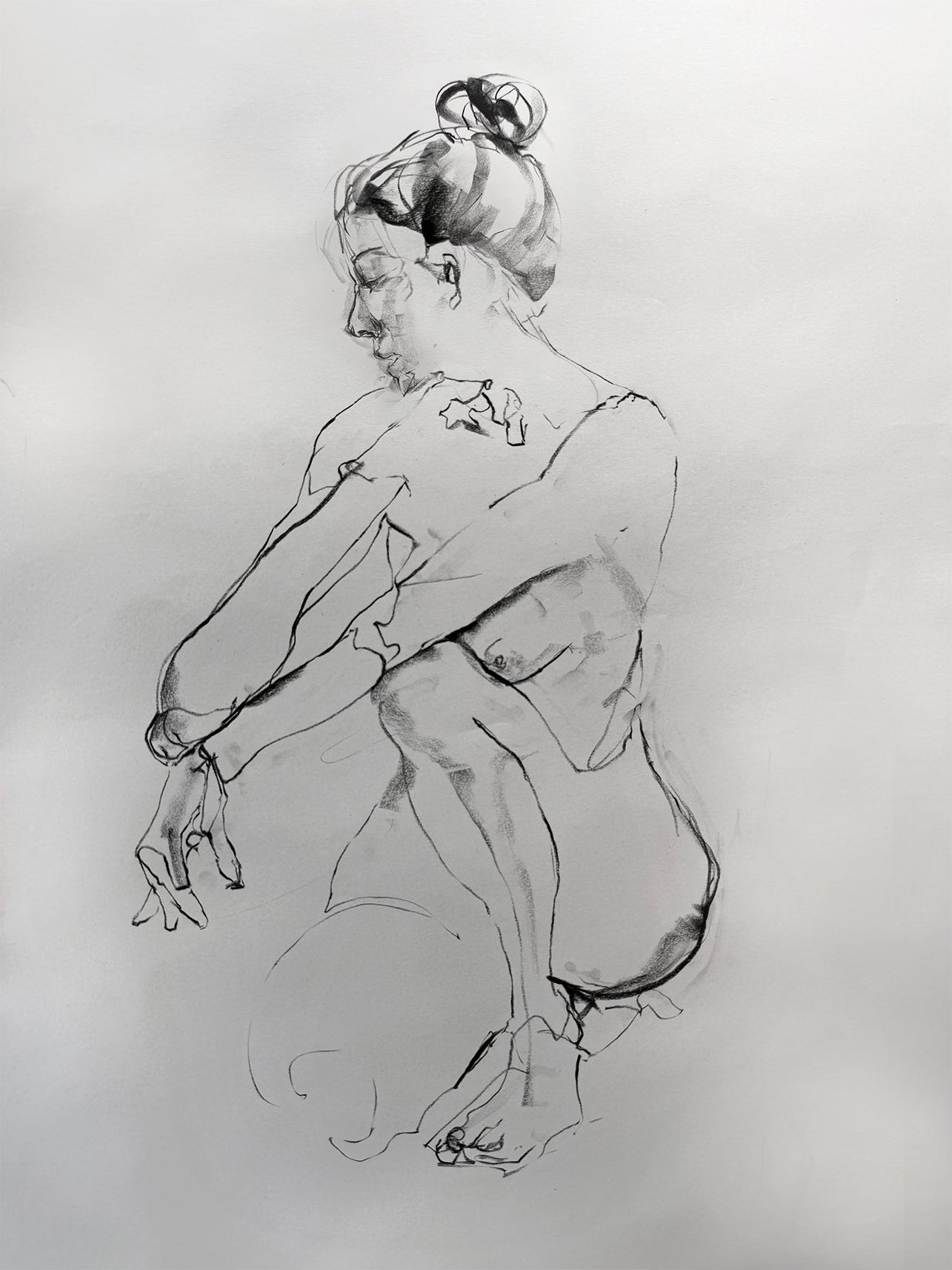
Drawing is Seeing
Why Contour Drawing Works

The technique of Pure Contour results in drawings that don’t look good. They look like a tangled mess of lines which is disconcerting because as figure drawers, ALL we are trying to do is to draw what we see. Or to say it more precisely: to make a drawing on paper that matches what we see, exactly.
In “Drawing on the Right Side of the Brain” one of the first exercises is contour drawing and actually, pure contour drawing is one of the most powerful exercises you can do to improve your ability to draw what you see.
As Edwards states, despite the fact that it does not “produce a “good” drawing (in student’s estimations), it is the best exercise for effectively and efficiently enabling students to later achieve good drawing.” - p86.
Laaaaterrrrrr…..
It helps you to make good drawings later… because what this exercise is doing in the moment, is improving your ability to see, not necessarily your ability to make marks, or to copy precisely. “Drawing is seeing” after all. And truly seeing as you draw is not just a visual thing, it’s a deeply felt experience which you can drop into, turn on, access whenever your analytical processes quieten down and your creative processes are allowed to take control and handle the task at hand, ie drawing.
Truly gifted drawers are able to achieve this level of direct observation while drawing incredibly accurate work. Their drawings are beautiful, not tangled, and not a mess lol😅
But for most of us, to develop our abilities, we must rather spend our time making incoherent, crazy looking and abstract drawings… because this is really training us to see.
However, I’ve found it’s important to also show people the value and beauty in these pure contour drawings, to point out how incredibly observed and therefore stunning their pure contour drawings are, in and of themselves. Usually people will not see their work as such, but a good contour drawing can be powerfully beautiful even if it is a tangled mess of lines.
Edwards explains:
“You have drawn complex edges from actual perceptions. These are not quick, abstract, symbolic representations... They are painstakingly accurate, excruciatingly intricate, entangled, descriptive and specific marks.” - p89.
As my life drawing teacher once said: a “good” drawing is one that is beautifully observed.
And, so within the mess of lines of a contour drawing, amid the mismatched proportions, scale and perspective, are lines that describe shapes in a very truthful way. This is direct drawing, there are no substitutions for shapes, no shorthands or simplified curves for complicated areas; no symbols and no assumptions. Each and every line is connected to the act of observing in a very pure way.
Try a few contour drawings next time you’re at life drawing or working from home. It’s a great way to drop into “drawing mode”
Thank you for reading! I hope you are having a great week!